 Log in
| 1 | ||
| 1 | ||
| 1 | ||
| 1 | ||
| 1 |

Warning. This is long. I cover some basics of Austrian Economics at the basic introductory level. It seemed relevant to some points I want to make, and it's never wrong to get introduced to the ideas.
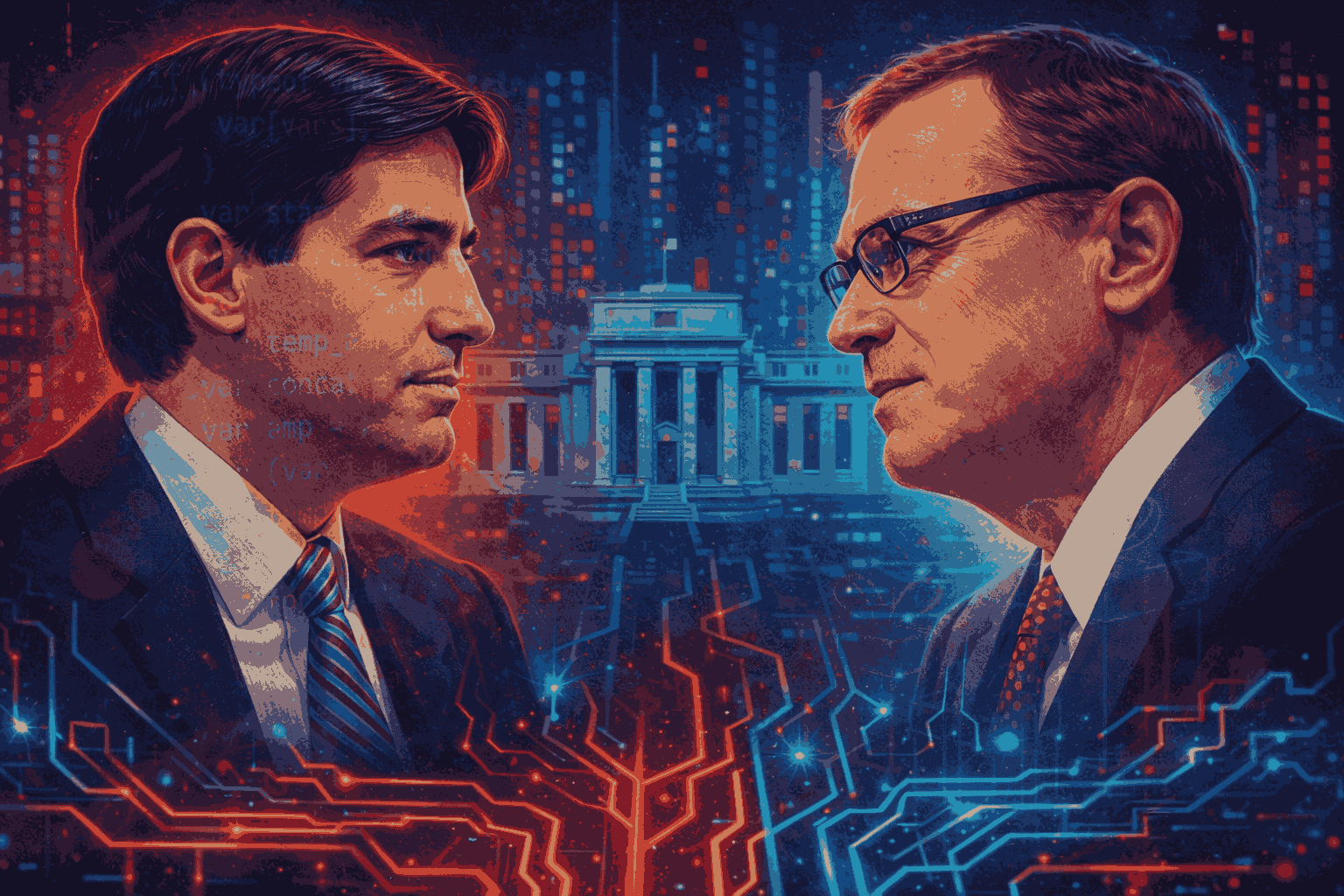
To start things off, let's start with a link. Who is Trump likely to nominate for Fed Chair if he successfully lets go of Powell?
https://polymarket.com/event/who-will-trump-nominate-as-fed-chair?tid=1765770432689
Here are the highlights from the time I am writing this. Kevin Hassett dropped from a high of 79% odds of getting the nomination earlier this week, to now 52%. While he is still the favorite, Kevin Warsh has now emerged as a notable possibility for the position. He started this week off with 11% odds and now sits at 40% odds.
We should take a look at who these people are and decide which of the two is preferable. I also want to mention that Grokipedia is entirely superior to Wikipedia. I'm going to link to both of their pages with both sources.
https://en.wikipedia.org/wiki/Kevin_Hassett
https://en.wikipedia.org/wiki/Kevin_Warsh
The problem is these Wikipedia pages aren't helpful, in my opinion, for figuring out how they would perform or lead the Federal Reserve. The summary of the Wikipedia pages is that these people exist, and they have had jobs.
https://grokipedia.com/page/Kevin_Hassett
https://grokipedia.com/page/Kevin_Warsh
Much better. From this, we see that Kevin Warsh would prioritize price stability and wouldn't just keep interest rates low. To me, this is important because I see the level of investment in AI as part of a Fed induced bubble and a potential source of mal-investment for humanity, that we won't be able to undo. We should take things a little slower. The Fed’s interest rates really do set how aggressive the economy is with speculation. Higher interest rates favor an economy that solves real-world problems today, in the most practical way possible. Economies with artificially low interest rates, when they are held low for too long, become obsessed with long term efforts to make unicorn companies that take over the world. We get plays for long term power instead of problem-solving for a consumer who exists today.
Kevin Hassett, the current leader in the probabilities, has full buy-in on the Phillips curve. He thinks that the Fed's interest is maximum employment. This may sound nice to people who want more jobs, and don’t realize that employment trends to the same level in every country regradless of policy. You can have maximum employment at any interest rate level. But if you are familiar with Austrian Economics, you know what's wrong with the Phillips curve. The Phillips curve is an entirely empirical observation that ignores logic and thus doesn't bother itself with the bigger picture of how interest rates and labor relate long-term and why. It doesn’t tell us anything about the changing incentives in a market.
Ludwig Von Mises's view on business cycle theory predicts the Phillips curve, explains why it happens, and what happens down the road. The problem with the Phillips curve is that blind acceptance of empirical theories isn't real science. Logic, when done correctly, is more reliable than historical data. In physics, this is the difference between a law and a theory. And the extra beneficial result of using logic is that you've now freed up measurement to be an independent verification of your logic. But if you start with an empirically driven theory you can always add more complexity, re-fit parameters, and toss out unfitting outliers. Worse yet, you don't understand anything and can't reason any better than a junky who knows he feels good when he does a certain activity.
So, to understand Misesian Business Cycle Theory, we need to first understand Mengarian Value Theory.
Carl Menger was one of the first men to introduce humanity to the concepts of microeconomics. He developed his theories of subjective value and marginal calculation in the exact same year that another economist introduced pretty much the same idea within English speaking circles. But Carl Menger did this within the German-speaking world. The major difference is that Menger's theories have a little more structure for us to work with.
The first concept is that if something helps you preserve your life, you are going to value it. So an item that helps satisfy a real human need is going to be valued. This is called a first-order good. Next, an item that helps you obtain or create one of these first order goods is also going to be valued. This is called a second-order good. And this actually flows up a chain. I might as well mention that there is also this idea of goods whose value depends on the presence of another good called coordinate goods. A pencil has no value without paper and paper has very little value without some kind of writing implement. It’s the same with a broom and dust pan. Or a craftsman and tools. Neither has very much value without the other. Now, these goods can either be durable or consumable. That can be true for a first-order good like food, which is consumable, or a first-order good like a house, which provides shelter. This can also be true of a second-order good. Paint can help me make a shirt in a screen printing business. But so can a screen frame. So can the building someone uses to make the shirts in. But none of them can directly feed me or anyone else. 2nd order goods and higher that are durable are called capital goods.
The thrust of the theory is that for something to be valuable or valued, it needs to be a part of a tree that helps you survive or meet some other human need, or trick you into thinking it does. This can also be tied to another theory that post-dates his, which is Maslow's hierarchy of needs. So in an updated interpretation, for something to be valued in Mengarian terms, it needs to fit somewhere into a plan to satisfy a Maslow need or be useful in someone else’s plan.
This differs from hyper-subjectivism, which says people value things because they value them. The predicate of hyper is necessary because Menger's idea is the original subjective value theory. The subjective quality in classical subjective value theory is that because you and I have different circumstances in that we have different needs, and different current existing co-ordinate goods like skills and tools, we value things differently. If I don't know how to weld, then the welder I bought off Amazon has very little value. But you might be able to do something really useful with it. You may be able to solve a real problem with it. This was apparently a new concept at the time because people had thought that value was objective (not dependent on who was valuing it), and there was a significant debate on how it was supposed to be calculated and what drives it.
Ok. The short version of Mengarian value theory is out of the way. The long version is here. Now onto Misesian Business Cycle theory.
The short version of MBCT is that the exact amount a second-order good is valued depends on interest rates. Or more accurately, it will depend on the working discount rate of the person valuing it, which will tend toward the market interest rates. Mises introduces this kind of outdated concept of the window of concern. It's kind of OK to think of it as being the payback period of an investment. The more modern concept is that people have a distribution of concerns for different times in the future, and they follow an exponentially decaying weight. But the window of concern can just be thought of as the average of that distribution.
The point is that if I can buy a machine that can produce 2 grommets a minute and will never break and doesn't require any other inputs, and my period of concern is 10 years, then I value that machine at approximately 10,519,236 grommets, whatever that's worth. In reality, you've got some accounting to do for a lot of other factors. Also, in the most pure scenario, you really have some math to do with some exponential terms. The important thing is that it is generally proportional to 10.5M grommets. If something causes us to double or halve the period of concern, the subjective value of this machine can double or halve. What's also interesting is that some of the extra accounting we didn't do can make this effect stronger due to a margin effect.
Now, do prices for capital goods swing that badly? In some cases, they can, like housing. But also, some of these prices are dependent on supply-side factors. So while your subjective valuation of a machine might be double, you might not pay that much because it doesn't cost that much to produce one. But we are shifting the demand curve, and the volume for those machines will increase. Which means, and we are tying the important part of this theory together, anything that is involved upstream in producing those machines just went up in value. The customer is willing to pay more. There are more customers above the minimum price threshold so there is a growing market. So what happens to the subjective value of third order goods? At the third level we have customers that are willing to pay more, a growing market that needs to be captured, and our own window is expanded in the same market conditions. What about the effects on our suppliers, the forth level? fifth level? sixth level?
Anyone who simply values people being busy would see this as an ideal situation. But can it continue forever? Mises says no. The resource limits ultimately push back. Or the world burns itself trying to extract resources, looking to solve problems that got way over emphasized by the market's miscalculation in a non-free market. It's sad that environmentalists rarely taken an interest in interest rates. If they did, there would be an End Fed poster at every environmentalist rally.
What is really scary is that the Fed lowers interest rates by printing money (letting banks have basically free money to keep them lending at those rates, without running out of cash, basically is printing money). This also causes inflation. Which means our real interest rate can go negative. That is when an interest rate is below the inflation rate. The effective window of concern at that point is infinitely into the future.
So companies aren't trying to solve problems we have today. They are trying to completely win the endgame. What does endgame mean? I guess this depends on what they envision. And if they are far enough back in the supply chain, investors will speculate they are deserving of infinite money and resources with which to do it. And given how many resources they have to do it, they'll probably succeed, or almost as bad, crash out our economy and environment trying.
And every time we have a financial bubble produced by low interest rates, we produce things that don't actually have value for humanity and end up being permanent negatives. We didn't need all the housing produced in the housing bubble. All we got was the first wave of migrants. The loss of homogeneity is the central focus of almost all political tension today. The bubble popping didn't solve the problems the bubble introduced. What did the dot-com bubble bring us? We didn't need the entire world addicted to the internet. We didn't need technocrats having cracked human attention. We didn't need the surveillance apparatus developed to serve ads with 10% more efficiency. See how disproportionate the market can get. We have a near-perfect surveillance apparatus that was developed to deliver low-value spam. Is that a proportionate thing to have built for something we don’t need to do better? This happened because the market calculated that ad delivery had infinite value. That's not a flaw in capitalism. That's a flaw in capitalism with manipulated interest rates. The dot-com crash happened, and we still have the surveillance apparatus.
And we very much do not need hyper-intelligent computers writing their own software, becoming infinitely intelligent and replacing all humans, thus creating an infinite robot intelligence that is perfect at acting in a world without meaning or purpose. What is the infinitely intelligent robot going to do once there is no purpose? It's quite literally the worst idea anyone could ever come up with. We are actually doing it, and we are at a point where we don't know if we can stop it. Guys, this is actually happening. This is actual reality. We are already to a point where we can't undo a lot of the things that have already developed. And we are 1% through it.
Every one of these permanent problems humanity develops for itself always ends up tied to one of these bubbles. And the worst part is, no amount of this being a bubble is going to undevelop the worst idea humanity ever had.
So if I am even potentially right about the interest rates, for the sake of humanity, raise them. Will that cause a horrific recession? Yes. But a horrific recession would shut down the AI companies. And we'd fucking survive it.
In short, this is why I favor Kevin Warsh to be nominated by President Trump as Federal Reserve Chairman.
I missed an important point. The Kevin Hassett guy in response to AI related job losses would lower interest rates to get back to maximum employment. But that would just further invest into the thing that is destroying jobs. I'm not a 'jobs have value in themselves' kind of guy. But it would be interesting to see how he reacts to that positive feedback loop? When would he figure out he's part of it? If he buys in on the Phillips curve the answer is never.
"So to understand Misesian Business Cycle Theory we need to first understand Mengarian Value Theory. "
Can you point normies to one specific place to learn about these things?
I hate to admit it but this is TL;DR to me
There is a book written by him. https://cdn.mises.org/principles_of_economics.pdf
But that's even more TL;DR. Unfortunately I gave the short version. The two shorters version I could have done is not bring it up. Or hand wave, MVT+MBCT (assuming everyone knows what that is) means low interest rates results in a hot economy but for bad reasons. But I decided to just commit and actually explain it.
Because a lot on the left always value low interest rates because they only see paying less on a mortgage. And also because they always trust the Fed because they blindly agree with institutions (unless they are watching a movie with Matt Damon and they are temporally the people who question institutions, till they get in a debate IRL about something actually current, then institutions must be trusted). Because of those things I think it's worth explaining like I'm two (even if long) why mal-investment happens. And why low interest rates give you a temporary inducement of jobs and why understanding the why matters, which unfortunately is not mainstream economics to care why.
So why bother considering how someone on the left would read it? I guess I just want to make a universal explanation because I think this is actually important, and humanity really is fucked if we don't understand this stuff.
Thank you
I think this is very interesting reading and the explanations are much appreciated. I agree with the assessment toward the end. We are looking at a likely recession, and the selection of the Fed Chair will be related to that development. So I agree that interest rates that are consistent with the economy - ie. high rates at the moment - are important tools of the Fed.
As for Warsh, I am not sure he is still a serious contender, though he may be the best choice. I really don't know.
Hasset remains the leading contender for the Fed Chair position because of his ties to Project 2025 initiatives.
70 Percent of Trump’s Cabinet Tied to Project 2025 Groups and his selection of Fed Chair will be also be dictated by the Heritage Foundation and the America First Policy Institute (AFPI). Hassett served on AFPI's board in 2023, and he has been a featured speaker at multiple Heritage Foundation events.
Hassett has been a favorite for Fed Chair since at least April, and it's been understood since November of last year that Trump would be required by the Heritage Foundation to replace the fed Chair, and Warsh was last November considered the next potential Fed Chair during the 2025 presidential transition project.. So what changed earlier this year?
As with other government agencies, the Heritage Foundation continues this year its focus on handouts to the ultra wealthy and its deregulation of corporations. That's been its MO since the 1980s, and it's all summarized in the Project 2025 document. The current government has been considered the most openly corrupt since before 1913. There are various discussions online of the plans to weaken the Federal Reserve, and allow banks to be completely deregulated. "Project 2025 ignores history and 150 years of economic experience to push a boulder uphill proposing radical and unrealistic reforms that even most Trump Republicans probably don’t support." The general interest is to abolishing the Federal Reserve altogether, or as much of the institution as possible.
Project 2025 Would Allow Financial Disaster To Bolster Wall Street’s Bottom Line. "Nearly three decades of deregulation opened the door for banks, investment companies, insurers, and other firms to engage in the excessive risk-taking that culminated in the 2007–2008 financial crisis." "Elevated borrowing from the Federal Reserve suggests financial companies are crunched for cash" at levels reflecting the 2007/08 financial crisis. Project 2025 requires the transfer of authority and regulatory power from the Federal Reserve to the President and Congrss, in order to decrease the political independence of monetary policy.. Congress does nothing to regulate the Executive Branch's implementation of Project 2025 this year and would likely do nothing to protect the independence of the Federal Reserve. This would create economic instability and destroy the 20th century foundations of the US economy.
"The Project 2025 platform recommends winding down the Fed’s balance sheet holdings—currently worth more than $7 trillion—and limiting future asset purchases only to U.S. Treasuries. The central bank’s balance sheet ballooned after the 2007-08 financial crisis during multiple rounds of quantitative easing, or QE, then again during the Covid-19 pandemic, when the Fed sought to inject liquidity into the U.S. banking system through large-scale purchases of Treasuries and mortgage-backed securities. The Fed began to gradually shrink its balance sheet—a process called quantitative tightening, or QT—in June 2022." Project 2025 is in the process of continuing, since Trump's last presidency, of putting control of this 7 trillion in the hands of ultra wealthy. “In free banking, neither interest rates nor the supply of money is controlled by the government,” Project 2025 reads. “The Federal Reserve is effectively abolished, and the Department of the Treasury largely limits itself to handling the government’s money.” This is a further destruction of financial protection of the US and your bank account and job and the economy in general. Hassett would be expected to continue this trend, and he's shown the ability to do so.
“The last time Kevin Hassett had a say in our economy, he helped Donald Trump roll out a disastrous MAGAnomics tax scam that rigged the economy for the ultra-rich on the backs of hardworking Americans. Now, Trump is bringing Hassett back to enact his devastating Project 2025 plans to raise middle class taxes, hike costs, and cut programs like Social Security and Medicare — but Democrats are ready to stand up to Trump’s all-out assault against hardworking Americans’ pocketbooks.”
Trump/Heritage Foundation previously picked Kevin Hassett to lead the National Economic Council, a role that puts him at the center of the administration’s policy-making discussions from trade to taxes and deregulation.
"Hassett helped shape Trump’s MAGAnomics tax scam that rigged the economy for the ultra-wealthy and big corporations…"
Washington Post: “A longtime conservative economist, Hassett helped shape the 2017 Republican tax law and has been a staunch defender of the president’s policies on other issues.”
The New York Times: “In the administration, [Hassett] has been a champion of the corporate tax cuts that Mr. Trump signed into law in late 2017 and a stalwart optimist about the economic growth those tax cuts could spur for years to come.”
CNN: “Kevin Hassett Defends Tax Cuts Amid Slowing Business Investment” … which didn’t cut taxes for working Americans but helped raise corporate executive salaries dramatically.
Center on Budget and Policy Priorities: “Like the Bush tax cuts before it, the 2017 Trump tax cut was a trickle-down failure.”
"Just like Trump, Hassett backs cuts to Social Security and Medicare."
PBS Newshour: “I mean you not only argue, Kevin Hassett, that belts should be tightened, you argue for much deeper cuts in entitlement programs like Social Security and Medicare in this country, and the equivalent programs in Europe.” Hassett: “Yeah that’s right. …”
I think Hassett is the Heritage Foundation's pick for Fed Chair, because "he has served, he will be of service."
Very interesting. You mentioned that Warsh was a high consideration before. But the interesting question is why is he suddenly a consideration again? Both have obviously been on Trump's radar this entire time. But for some reason Trump was motivated to say he likes Warsh for Fed Chair recently. Did Hassett piss him off in some way?
A lot of these policy agreement that you mentioned wouldn't be very relevant from the role of a Fed Chair.
But the Fed doesn't have control over that. Maybe these areas of agreement are exactly why he would be kept out of Fed Chair to use him for a role where this alignment would be relevant.
Thanks for this. I think the reason for a long campaign by the White House for both candidates and the change in polymarket odds relates to another delay for the nomination, to early in 2025. https://fortune.com/2025/12/15/fed-chairman-candidates-hassett-warsh-waller-rieder All three factors are related to the ongoing negotiations (& "donations") with Republicans for their confirmation votes.
Cuts to Social Security and healthcare date back to Regan era, as well as massive tax cuts, all of which led to the 1990-91 recession. The same is happening with the Republican party today. The Heritage Foundation's choice of Fed Chair will reduce the Fed to an interest rate calculator, while siphoning off $7 Trillion in assets (published in Project 2025, and noted at the links, in yellow, above). The pattern we've seen is that, to afford the austerity, cuts to "entitlements" like Social Security and healthcare will follow, rather than cuts to the 800 US military bases.